
AI Adoption Beyond the Hype: Building Business-Ready Intelligence
Artificial Intelligence (AI) has rapidly evolved from a futuristic concept into a strategic business priority. Organizations across industries are investing in AI to automate operations, improve customer experiences and gain valuable business insights. However, while AI promises significant transformation, many organizations struggle to convert that promise into measurable business outcomes.
The challenge isn't the technology itself, it's how businesses adopt it. Successful AI adoption requires more than implementing advanced tools. It demands clear business objectives, quality data, skilled teams and a structured implementation strategy. Instead of chasing trends, organizations should focus on building business-ready intelligence that creates sustainable value.
Why AI Adoption Is More Than Technology
Many companies assume that purchasing AI software automatically leads to innovation. In reality, AI is only effective when aligned with business goals.
A successful AI initiative begins by identifying business challenges rather than selecting technology first. Whether it's reducing operational costs, improving customer service, or enhancing decision-making, AI should solve a specific problem with measurable outcomes.
Organizations that treat AI as part of their overall digital transformation strategy are more likely to achieve long-term success than those implementing isolated AI projects.
Common Challenges in AI Implementation
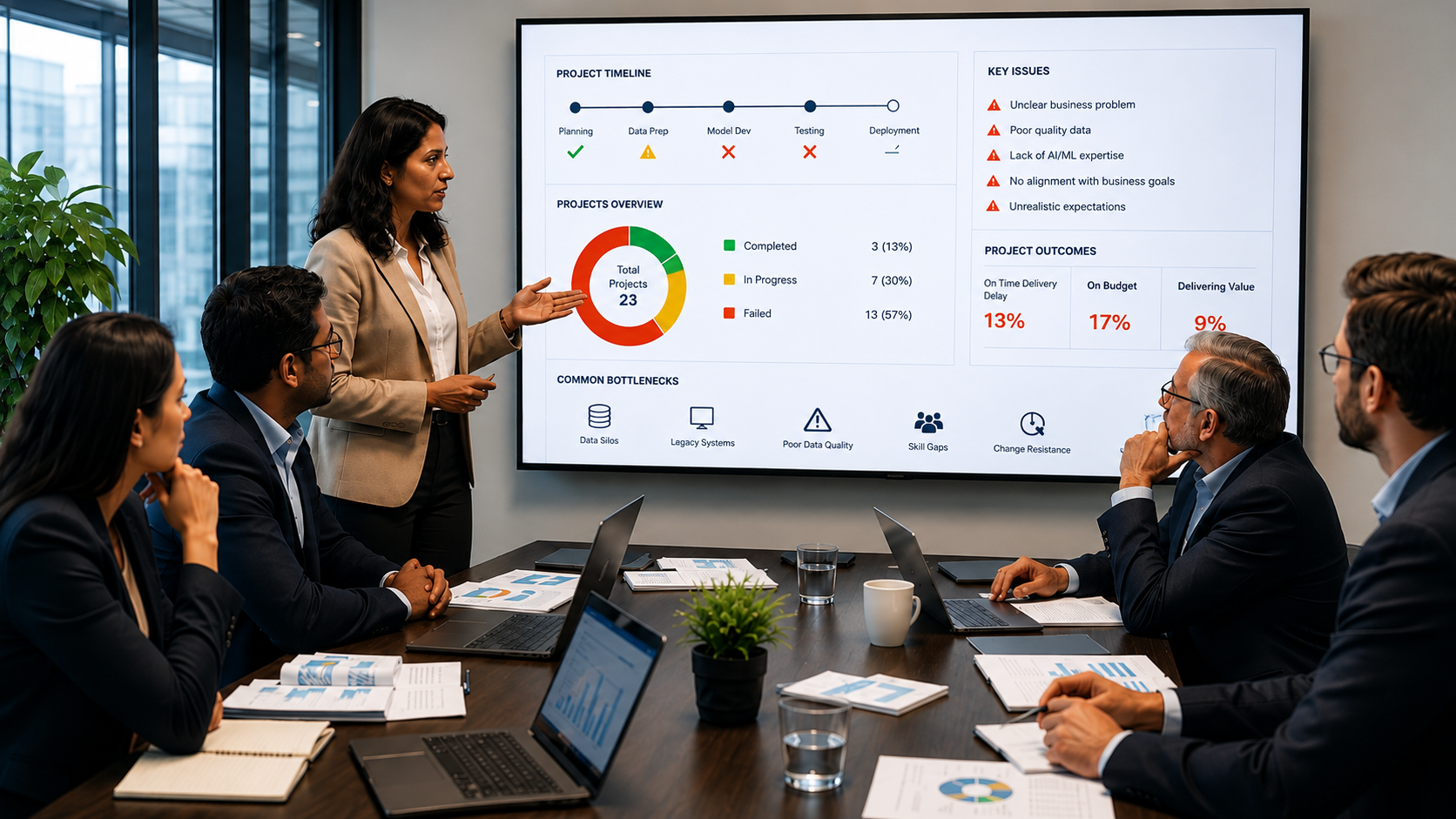
Despite growing investments, many AI initiatives fail to achieve expected results due to several common obstacles.
Poor Data Quality
AI models rely on accurate, consistent and relevant data. Incomplete or outdated information often leads to unreliable predictions and poor business decisions.
Lack of Clear Business Objectives
Without defined goals, AI projects quickly lose direction. Businesses should establish measurable KPIs before implementation.
Resistance to Change
Employees may hesitate to adopt AI because of uncertainty or concerns about job security. Effective communication and proper training encourage acceptance and collaboration.
Integration Complexity
Many organizations use legacy systems that aren't designed for AI integration. Modernizing infrastructure and ensuring compatibility are essential for successful implementation.
Building a Business-Ready AI Strategy
Organizations should approach AI adoption with a structured roadmap rather than isolated experiments.
1. Identify High-Impact Use Cases
Start with business problems where AI can provide measurable improvements. Focus on practical use cases that deliver clear business value and quick wins.
- Customer Support Automation
- Predictive Maintenance
- Sales Forecasting
- Fraud Detection
- Intelligent Document Processing
Selecting practical AI applications builds confidence and demonstrates measurable business value from the beginning.
2. Build a Strong Data Foundation
Data is the backbone of every successful AI solution. Businesses should establish a reliable data strategy before implementing AI technologies.
- Data Accuracy
- Data Governance
- Security & Compliance
- Centralized Data Management
- Continuous Data Monitoring
High-quality, well-managed data significantly improves AI performance and delivers better business outcomes.
3. Develop AI-Ready Teams
Technology alone doesn't create transformation. Organizations need skilled people who understand both AI capabilities and business objectives.
- Employee Training
- AI Awareness Programs
- Cross-Functional Collaboration
- Change Management Initiatives
Combining technical expertise with business knowledge leads to more successful and sustainable AI implementations.
4. Start Small and Scale Gradually
Instead of deploying AI across the entire organization at once, begin with pilot projects that can be tested and refined.
- Validate Return on Investment (ROI)
- Improve AI Models
- Gather Employee Feedback
- Reduce Implementation Risks
Successful pilot projects create a strong foundation for expanding AI initiatives across the business.
Best Practices for Successful AI Adoption
Organizations that achieve sustainable AI success often follow these best practices:
- Define measurable business goals before selecting AI tools.
- Focus on solving real business challenges instead of following trends.
- Maintain high-quality, secure, and well-governed data.
- Monitor AI performance regularly and optimize models over time.
- Ensure transparency and ethical AI practices.
- Encourage collaboration between business leaders and technical teams.
- Continuously measure ROI and operational improvements.
A disciplined approach helps businesses maximize the value of their AI investments.
The Future of AI in Business
AI will continue to reshape industries by enabling smarter automation, predictive analytics and personalized customer experiences. However, competitive advantage will belong to organizations that combine AI capabilities with strategic planning and responsible governance.
Emerging technologies such as Generative AI, intelligent automation and AI-powered decision support will further accelerate digital transformation. Businesses that invest in AI readiness today will be better positioned to adapt to changing market demands and technological advancements.
Rather than replacing human expertise, AI will increasingly serve as a collaborative tool that enhances productivity, supports innovation and enables faster, data-driven decision-making.
Conclusion
AI adoption is no longer about experimenting with the latest technology; it is about creating measurable business value. Organizations that align AI initiatives with business objectives, build strong data foundations, invest in people and implement AI responsibly are more likely to achieve long-term success.
Instead of chasing the latest AI trends, businesses should focus on practical implementation strategies that solve real-world challenges and support sustainable growth. With the right technology partner, this transformation becomes more effective and scalable. At Solvencia, we help businesses move beyond the hype by delivering AI-powered solutions that align with their goals, improve operational efficiency and create lasting competitive advantage. By combining strategic expertise with innovative technologies, Solvencia enables organizations to build business-ready intelligence that drives meaningful and measurable outcomes.
Frequently Asked Questions
AI adoption is the process of integrating Artificial Intelligence technologies into business operations to improve efficiency, automate tasks and support better decision-making.
Businesses should define clear goals, build a strong data foundation, train employees and start with small pilot projects before scaling AI initiatives.
AI helps organizations automate repetitive tasks, improve customer experiences, reduce operational costs, enhance decision-making and increase overall productivity.
OUR LATEST BLOGS
Read more blogs of our company
Are you busy reading out IT fires instead of focusing on your core business

MOBILE DEVELOPMENT
OpenAI launches new alignment division to tackle risks of superintelligent AI
The makers of AI have announced the company will be dedicating 20% of its compute processing power over the next four years
- Collaboration Tools
- Smart Reminders

WEB DEVELOPMENT
New EU battery law could mean EOL for low-cost smartphones
Apple might have wriggle room for the iPhone when it comes to new EU laws to make smartphone batteries user replaceable
- Collaboration Tools
- Smart Reminders
- Requirement
- Task Management

CLOUD COMPUTING
FTC reported to be investigating OpenAI for consumer protection violations
OpenAI is reportedly under additional legal scrutiny, as the US Federal Trade asks the company to give detailed explanations
- Collaboration Tools
- Smart Reminders
- Requirement
-
15+
Years of Experience
-
25+
Satisfied Clients
-
100%
Project Delivery Rate
-
100+
Skilled Professionals

Contact Info
+91-7416578822
info@solvencia.in

Visit our office
501 Vipras Elite, Door No: 1/90/7/B/79/22A Street No: 1, Patrika Nagar HITEC City, Hyderabad Telangana 500081